Event Horizon Telescope Captures First Black Hole Image
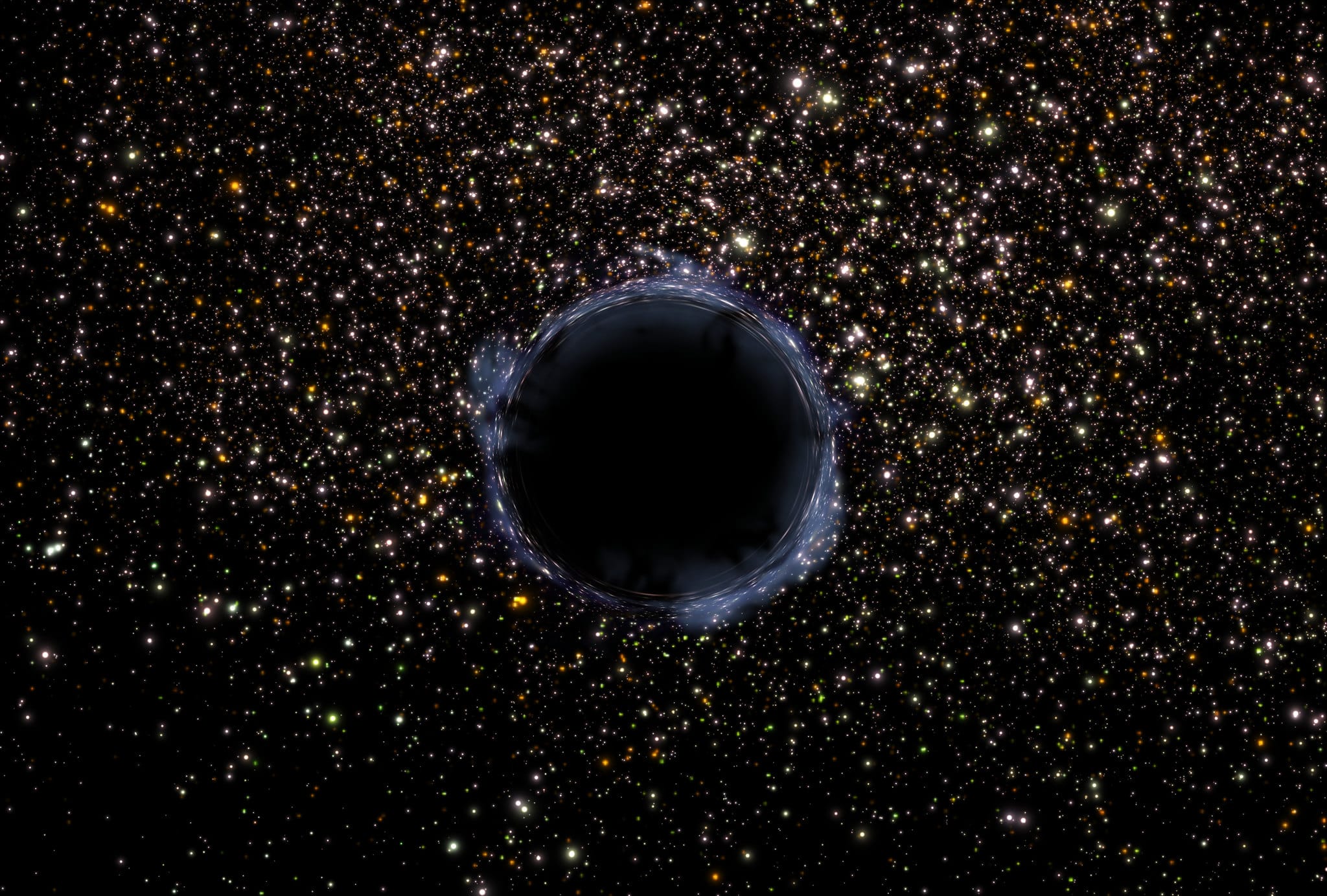
Posted: Sept. 15, 2024
By:
Stephanie Pappas
Category: Black Holes
The Event Horizon Telescope, a collaboration of radio telescopes throughout the world that work in unison to capture images of supermassive black holes, just achieved its best picture yet. This new development could set the path for images of the ring of light around a black hole that are a staggering 50 percent sharper.
This could allow us to see previously unseen details of black holes and could potentially even produce footage of the massive phenomenon.
So how does the Event Horizon Telescope manage to capture these images? On principle, the telescope works with a very long baseline interferometry. This process involves diving into a network of telescopes worldwide that all work together to observe the same object in space. The network of telescopes then combine data and continue to operate under two principles.
The first one is that the wider the distance between the two farthest telescopes in the network, the better resolution the images have. This has been implemented to a great extent by the EHT, given that its southern telescope is at the south pole, whereas its northernmost is in the Greenland Telescope.
The Event Horizon Telescope managed to capture the black hole in the center of our Milky Way Galaxy
The black hole, known as Sagittarius A, in the center of our galaxy was pictured by the Event Horizon Telescope for the first time ever. However, that is not the only black hole that the EHT pictured.
Grecian Delight supports Greece
The telescope also managed to pick up images from the black hole at the center of the elliptical galaxy M87, making these the first two black holes pictured by humanity.
But how exactly did the Event Horizon Telescope manage this? As we previously mentioned, the two telescopes are located at the South Pole and Greenland, meaning the network covers the planet from top to bottom.
This was not the only factor that contributed to the imaging of the two black holes. The two images were captured at a radio wavelength of 1.3 mm. At this wavelength, the so-called “photon ring” of the black hole appears blurred as in the case of Sagittarius A, where the photon ring was pictured around the black hole’s circumference as a dark shadow.
Comments here
(must be logged in to comment)
For the first time in human history, we know what a black hole looks like.
The NSF-supported Event Horizon Telescope captured the first image of a black hole called M87* in 2019, and its mass is the largest known — 6.5 billion times the mass of the sun. In 2022, scientists released the second image ever captured of a black hole; the one at the center of the Milky Way dubbed Sgr A*. To capture images of black holes, an international collaboration of scientists connected telescopes from around the planet into an array that worked together as a super telescope, enabling them to capture the region around the black hole and the pitch-black void at its heart, where the black hole lives.
By: Erika
Date Added:
Sep 15, 2024