Aurora alert: Powerful geomagnetic storm could spark northern lights across US and Europe tonight
Posted: Sept. 16, 2024
By:
Daisy Dobrijevic
Category: Solar Storms
G3 geomagnetic storm conditions are predicted for Sept. 16. Aurora hunters keep your eyes on the skies!
A combination of powerful solar events has prompted the National Oceanic and Atmospheric (NOAA) Space Weather Prediction Center (SWPC) to issue a geomagnetic storm warning for today (Sept. 16).
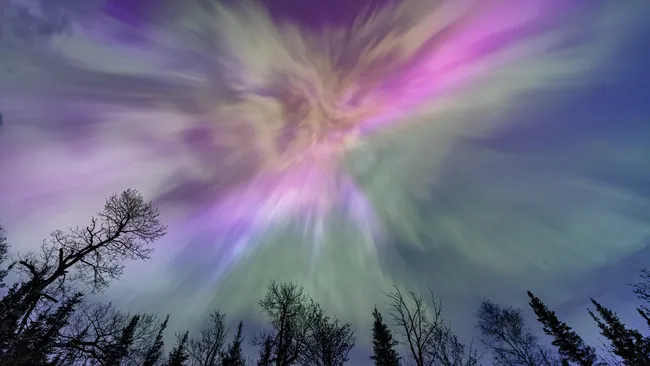
This is great news for those wishing to see the northern lights the predicted geomagnetic storm could spark auroras deep into mid-latitudes (around 50°) and as far south as California, Missouri and Oregon.
This culprit? In this case, there are actually two.
The first is a large plume of plasma and magnetic field known as a coronal mass ejection (CME) that was released from the sun during a colossal X-class solar flare — the most powerful class of solar flare — on Sept. 14. The X4.5 solar flare peaked at 11:29 a.m. EDT (1529 GMT) and was the fifth largest solar flare of the current solar cycle.
The CME released during the X-flare is currently barreling toward Earth and is predicted to arrive today (Sept. 16). CMEs carry electrically charged atoms known as ions. When they collide with Earth's magnetosphere, they can trigger geomagnetic storms. During these storms, the ions interact with gases in Earth's atmosphere, emitting energy as light. It is this light that we view as the northern lights, or the aurora borealis, in the Northern Hemisphere, and the southern lights, or the aurora australis, in the Southern Hemisphere.
The second culprit is a coronal hole on the Earth-facing side of the sun. Coronal holes appear as dark regions in the sun's corona (outer atmosphere). They have an open, unipolar magnetic field line structure which essentially allows the solar wind to escape more readily into space. This stream of relatively fast solar wind and the influence of the incoming CME have resulted in the G3 geomagnetic storm watch being issued.
NOAA classifies geomagnetic storms using a G-scale that measures their intensity, ranging from G1 for minor storms to G5 for the most extreme ones. Powerful G3 conditions are predicted for today (Sept. 16) which means we could be in for quite the aurora show as previous "minor" G1 conditions on July 29/30 still managed to spark dazzling northern lights across the U.S. and Canada.
Comments here
(must be logged in to comment)
Great
By: yellowcat
Date Added:
Nov 11, 2024