SN 1987A for Chandra's 25th Anniversary
Posted: Sept. 6, 2024
By:
Bruce Draine
Category: Astro Physics
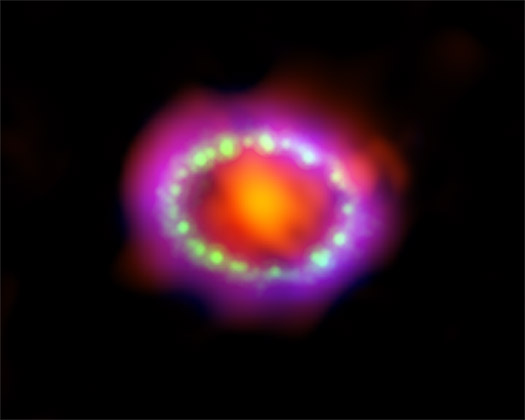
SN 1987A for Chandra's 25th Anniversary (Chandra/Webb/Hubble composite) The supernova explosion that created this object was first observed on Earth in February 1987. Chandra sees X-rays produced by debris from the explosion. X-rays from Chandra (purple); optical and infrared from Hubble (red, green, blue); infrared from Webb (red, green, and blue) Read more about Chandra's 25th anniversary: chandra.cfa.harvard.edu/photo/2024/25th/ Credit: X-ray: NASA/CXC/SAO; Optical/Infrared: NASA/ESA/STScI; Infrared: NASA/ESA/CSA/STScI; Image Processing: NASA/CXC/SAO/J. Major Visual Description: At the center of this composite image is a small object resembling a glowing pink Cheerio. This is supernova SN 1987A, named after the year the core-collapse explosion was first observed on Earth. It is located in the Large Magellanic Cloud, a small nearby galaxy. The pink Cheerio, or equatorial ring, represents material ejected tens of thousands of years before the supernova explosion. The blast wave from the supernova is striking the ring, causing it to produce X-rays detected by Chandra. Inside this ring is a pale, steel blue dot containing debris from the star that exploded.. The ring sits at the center of a ghostly figure 8, outlined in brick orange. This entire structure is surrounded by a packed field of stars, specks and dots in white, blue, and orange. A long, brick orange cloud hovers near the left edge of the image.
Comments here
(must be logged in to comment)
The explosion of supernova SN 1987A was caused by the core collapse of a massive star that ran out of fuel. This triggered a powerful supernova, ejecting the star's outer layers into space and producing the emissions observed from Earth.
By: Lou-Friedman
Date Added:
Sep 6, 2024
This composite image of supernova SN 1987A, created for Chandra's 25th anniversary, combines data from Chandra, Hubble, and Webb. It shows the aftermath of a stellar explosion first observed in 1987. The pink ring at the center represents material ejected before the explosion, now illuminated by the blast wave. Chandra's X-ray data (purple) reveals the high-energy interactions of the debris, while Hubble and Webb show the structure of the supernova remnant. This image showcases the ongoing evolution of the supernova.
By: Erika
Date Added:
Sep 6, 2024