Posts in Solar Storms
Aurora alert: Powerful geomagnetic storm could spark northern lights across US and Europe tonight
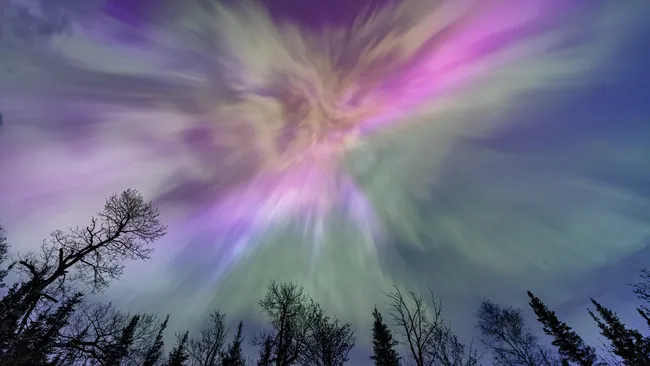
G3 geomagnetic storm conditions are predicted for Sept. 16. Aurora hunters keep your eyes on the skies! A combination of powerful solar events has prompted the National Oceanic and Atmospheric (NOAA) Space Weather Prediction Center (SWPC) to issue a geomagnetic storm warning for today (Sept. 16). This is great news for those wishing to see the northern lights the predicted geomagnetic storm could spark auroras deep into mid-latitudes (around 50°) and as far south as California, Missouri and Oregon. This culprit? In this case, there are actually two. The first is a large plume of plasma and magnetic field known as a coronal mass ejection (CME) that was released from the sun during a colossal X-class solar flare — the most powerful class of solar flare — on Sept. 14. The X4.5 solar flare peaked at 11:29 a.m. EDT (1529 GMT) and was the fifth largest solar flare of the current solar cycle. The CME released during the X-flare is currently barreling toward Earth and is predicted to arrive today (Sept. 16). CMEs carry electrically charged atoms known as ions. When they collide with Earth's magnetosphere, they can trigger geomagnetic storms. During these storms, the ions interact with gases in Earth's atmosphere, emitting energy as light. It is this light that we view as the northern lights, or the aurora borealis, in the Northern Hemisphere, and the southern lights, or the aurora australis, in the Southern Hemisphere. The second culprit is a coronal hole on the Earth-facing side of the sun. Coronal holes appear as dark regions in the sun's corona (outer atmosphere). They have an open, unipolar magnetic field line structure which essentially allows the solar wind to escape more readily into space. This stream of relatively fast solar wind and the influence of the incoming CME have resulted … ...
[Read More]
Sun fires off X-class solar flare, increasing aurora viewing chances into weekend
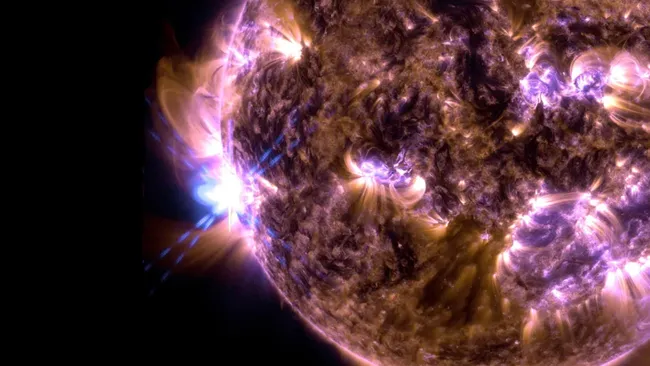
It's been a busy week for solar activity with more powerful solar flares and geomagnetic storm possibilities in the forecast. A parade of solar activity continues to flow from the sun this week, opening up more chances to spot the aurora across the United States this weekend. On Thursday morning (Sept. 12), a sunspot region that has not been numbered yet made its presence known blasting off a X1.3 class solar flare. X-class solar flares are the most powerful of their kind, and are typically followed by a full or partial loss of high frequency (HF) radio signals for sunlit locations on our planet. The energetic eruption, which peaked at 5:43 AM EDT (943 UTC), brought impacts earlier this morning with communication bands across Africa, Europe, and parts of Asia. Forecasters at NOAA's Space Weather Prediction Center will continue to analyze the data to confirm how many more CMEs could reach Earth's magnetic field both from the X-class flare and also a group of M-class flares (the second strongest in class) also generated early Thursday by two previous sunspots, or Active Regions (AR), designated AR 3811 and AR 3814. ...
[Read More]